
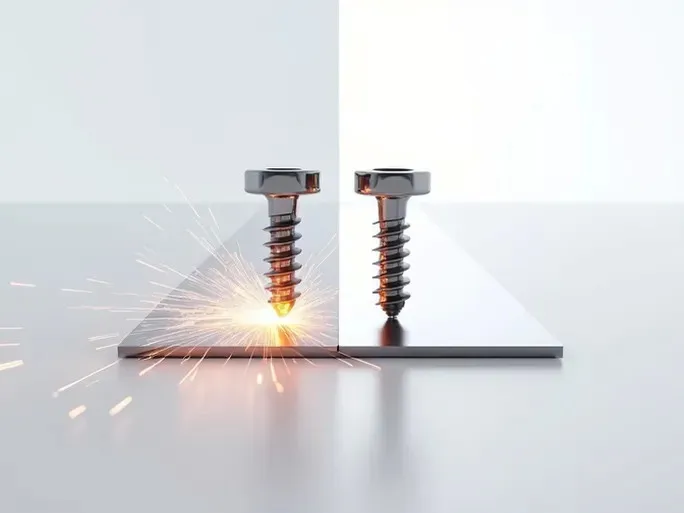
When structural joint reliability is critical, selecting between self-drilling and self-tapping screws becomes more than a trivial decision. Each type excels in specific applications, and understanding their performance differences is essential for optimal design.
Key Performance Differences
Self-drilling screws, equipped with an integrated drill bit, combine drilling and fastening into a single operation. This feature significantly improves efficiency, particularly in thin sheet metal connections. Their design minimizes the need for pre-drilling, reducing labor time and costs.
In contrast, self-tapping screws require pre-drilled holes but often deliver superior joint strength. By engaging with prepared threads, they distribute stress more evenly and typically cause less material deformation. This makes them preferable for applications where joint integrity is paramount.
The Role of Finite Element Analysis
Modern engineering increasingly relies on finite element analysis (FEA) to evaluate fastener performance. This computational method simulates stress distribution and deformation patterns under various load conditions. By comparing FEA results for both screw types in identical scenarios, engineers gain quantitative insights into their relative strengths.
FEA models typically examine critical factors including:
- Stress concentration points
- Material deformation characteristics
- Load-bearing capacity thresholds
- Fatigue resistance over time
Practical Selection Criteria
The optimal choice depends on multiple considerations:
- Material thickness and properties
- Required joint strength and durability
- Anticipated load types (static, dynamic, or vibrational)
- Installation constraints and accessibility
While self-drilling screws offer installation speed advantages, self-tapping screws frequently demonstrate better long-term performance in high-stress applications. FEA provides the analytical framework to balance these tradeoffs systematically.
Ultimately, the decision requires careful evaluation of technical requirements combined with computational validation. This approach ensures structural safety while optimizing both performance and cost efficiency.