
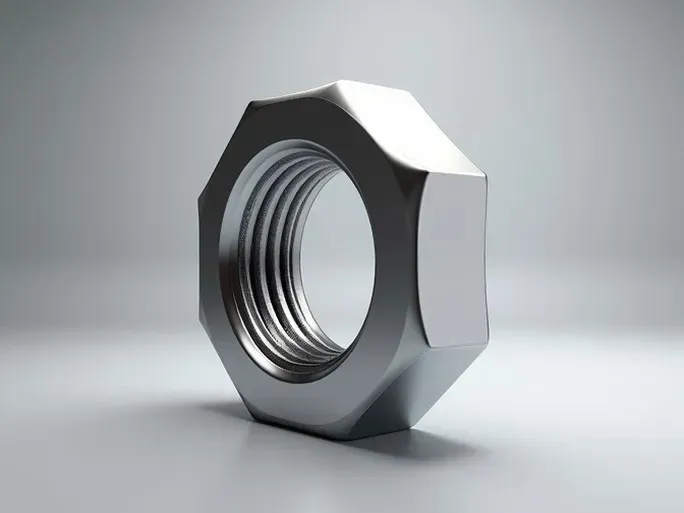
In the complex world of mechanical assembly, how can two seemingly unrelated threaded rods be securely joined to transfer forces and maintain system stability? The coupling nut emerges as the critical solution to this engineering challenge. Functioning as a specialized connector, it seamlessly integrates independent components, providing enhanced load-bearing capacity and expanded application possibilities.
Coupling Nuts: The Art of Mechanical Connection
Also known as extension nuts or connecting nuts, coupling nuts are internally threaded fasteners primarily designed to join two externally threaded rods—typically threaded rods, though sometimes used for pipe connections. Their exterior usually features a hexagonal shape for wrench tightening. The fundamental purpose of coupling nuts lies in extending connection length, reinforcing joint strength, and enabling the connection of differently sized threaded rods or pipes.
Primary Functions of Coupling Nuts
Connection extension:
The most basic function—when threaded rods lack sufficient length for direct connection, coupling nuts provide an effective bridging solution.
Dimensional adaptation:
Some coupling nuts feature different internal thread sizes at each end, enabling connections between dissimilar rod or pipe diameters.
Strength enhancement:
Their extended length increases thread engagement area, significantly improving resistance to tensile forces and torque compared to standard nuts.
Positional adjustment:
Offers fine-tuning capability for precise component alignment in applications requiring exact positioning.
Industrial Applications
Coupling nuts serve critical functions across multiple sectors:
Construction:
Essential for structural steel connections, formwork support systems, and scaffolding assemblies, ensuring structural integrity and worksite safety.
Mechanical engineering:
Connects machinery components including motors, pumps, and valves, facilitating power transmission and structural support.
Piping systems:
Enables pipeline extensions, directional changes, and fluid conveyance in various industrial settings.
Furniture manufacturing:
Provides robust joints for structural elements like table legs, chair backs, and bed frames.
Electronics:
Secures components and establishes reliable electrical connections in circuit board assemblies.
Technical Specifications and Material Selection
Coupling nuts are available in numerous configurations, categorized by several technical parameters:
Material Classification
Carbon steel:
The most common material, offering excellent strength and machinability. Variants include:- Low-carbon: General purpose applications
- Medium-carbon: Higher load-bearing capacity
- High-carbon: Superior strength and wear resistance
Stainless steel:
Provides exceptional corrosion resistance—304 grade for standard environments, 316 grade for marine/chemical exposure.
Alloy steel:
Enhanced strength through alloying elements (e.g., 40Cr, 35CrMo), suitable for extreme conditions.
Copper:
Preferred for electrical conductivity and corrosion resistance in electronics.
Aluminum:
Lightweight solution for aerospace and automotive applications.
Surface Treatments
Zinc plating:
Basic corrosion protection—electroplated (cost-effective) or hot-dipped (superior protection).
Nickel plating:
Combines corrosion resistance with aesthetic appeal for visible components.
Black oxide:
Creates protective oxidation layer, enhancing durability.
Dacromet coating:
Advanced protection against corrosion, heat, and weathering.
Geometric Variations
Hexagonal:
Standard wrench-friendly configuration
Cylindrical:
Space-constrained installations
Flanged:
Increased bearing surface for higher load distribution
Selection Criteria
Optimal coupling nut selection requires evaluation of four key parameters:
Material compatibility
with operational environment and load requirements
Surface treatment
appropriate for expected exposure conditions
Dimensional specifications
matching the connected components
Strength rating
(e.g., 8.8, 10.9) corresponding to anticipated mechanical stresses
Installation and Maintenance Protocols
Proper handling ensures optimal performance and service life:
Installation Best Practices
- Verify thread integrity and cleanliness before assembly
- Use appropriate tools—avoid over-tightening
- Employ torque wrenches for critical load-bearing applications
- Prevent surface damage during installation
Maintenance Guidelines
- Periodically check and re-tighten as needed
- Clean surfaces to remove contaminants
- Apply protective treatments in harsh environments
- Replace damaged or deformed units immediately
Specialized Variants: Coupling Mechanisms
While coupling nuts serve threaded connections, mechanical couplings perform analogous functions for rotating shafts:
Oldham couplings:
Accommodate parallel shaft misalignment
Universal (Hooke’s) joints:
Connect angularly offset shafts
Double universal joints:
Minimize angular transmission errors
Rigid couplings:
For perfectly aligned shafts
Flexible couplings:
Compensate for various misalignment types
Straight pipe couplers represent another related category, providing simple, slip-fit connections for standard piping systems.