
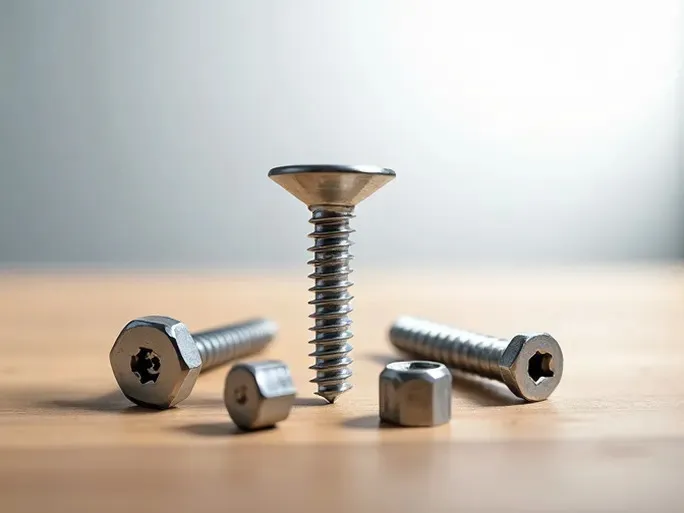
Have you ever struggled with installation difficulties, unsightly appearances, or even compromised structural integrity due to improper screw head selection? This comprehensive guide will help you navigate the diverse world of screw head types, ensuring you make the right choice for any application.
Understanding Screw Head Fundamentals
In the realm of fasteners, screws play a critical role in construction and assembly. The head of a screw serves not only as the tool engagement point but also determines its application suitability, load-bearing capacity, and final installation outcome. Different head designs address various functional requirements and aesthetic considerations. Selecting the appropriate screw head type can significantly enhance work efficiency, ensure reliable connections, and improve overall product quality.
Countersunk Head Screws: Flush Finishes and Aesthetic Appeal
Countersunk screws feature tapered heads designed to sit flush with or below the surface of the material being fastened, creating a smooth, unobtrusive finish ideal for applications where protrusions are undesirable.
Flat Head (82° Countersunk)
Characteristics:
Standard countersunk screw with an 82° conical head (US standard) or 90° (metric standard)
Applications:
Metal, wood, and plastic assemblies requiring flush surfaces, particularly in furniture manufacturing and electronics
Selection Notes:
Requires properly countersunk holes; note angle differences between US and metric standards
Undercut Flat Head
Characteristics:
Shorter conical section than standard flat heads, suitable for thinner materials
Applications:
Thin sheet connections or space-constrained installations
Selection Notes:
Offers longer thread engagement in short screws with slightly reduced load capacity
100° Flat Head
Characteristics:
Wider 100° conical angle optimized for thin materials
Applications:
Thin metal sheets requiring better conformity and stability
Selection Notes:
Requires matching 100° countersinks; incompatible with standard 82° holes
Oval Head
Characteristics:
Hybrid design with partially countersunk, domed top for decorative appeal
Applications:
Switch plates, decorative covers where aesthetics matter
Selection Notes:
Requires proper countersinking for correct installation
Round Head Screws: Versatility and Functionality
Round head screws protrude above the material surface, offering excellent versatility with numerous specialized variants for different requirements.
Pan Head
Characteristics:
Slightly domed circular head with flat bearing surface
Applications:
General-purpose fastening in machinery, electronics, and appliances
Selection Notes:
Moderate load capacity; not suitable for high-stress connections
Truss Head
Characteristics:
Extra-wide, low-profile head for superior load distribution
Applications:
Thin materials and plastics requiring pressure dispersion
Selection Notes:
Lower profile than standard round heads
Washer Head
Characteristics:
Integrated washer base for increased bearing surface
Applications:
Metal structures and machinery needing enhanced clamping force
Selection Notes:
Larger head size may affect aesthetics
Hex Head Screws: High-Strength Solutions
Hexagonal heads provide superior torque transmission for demanding applications requiring robust connections.
Standard Hex Head
Characteristics:
Conventional six-sided head for wrench or socket engagement
Applications:
Heavy machinery, structural, and automotive uses
Selection Notes:
Requires proper wrench sizing for optimal torque
Hex Washer Head
Characteristics:
Built-in washer protects surfaces and enhances clamping
Applications:
Metal fabrication and automotive assemblies
Selection Notes:
Often available with combo-drive options
Specialty Head Types: Targeted Solutions
Unique head designs address specific installation challenges and performance requirements.
Socket Head Cap Screw
Characteristics:
Cylindrical head with internal hex drive for flush mounting
Applications:
Precision machinery and tooling requiring clean profiles
Selection Notes:
Requires matching Allen keys
Bugle Head
Characteristics:
Flared design self-countersinks in drywall and wood
Applications:
Drywall installation and woodworking
Selection Notes:
Avoid overtightening to prevent material damage
Torx Head
Characteristics:
Star-shaped recess for superior torque transmission
Applications:
Automotive and aerospace where slippage is unacceptable
Selection Notes:
Requires specialized Torx drivers
Selection Methodology
Choosing the optimal screw head involves evaluating multiple factors:
Structural Requirements:
Hex heads or socket heads for high-load situations
Aesthetic Considerations:
Countersunk for flush finishes; oval for decoration
Material Compatibility:
Truss heads for soft materials; 100° heads for thin metals
Space Constraints:
Socket heads or undercut variants in tight spaces
Vibration Resistance:
Serrated heads for loosening prevention
Tool Availability:
Match drive type to available equipment
Conclusion
Proper screw head selection requires careful consideration of technical specifications, material properties, and application requirements. This guide provides the foundational knowledge needed to make informed decisions that ensure secure, functional, and visually appropriate fastening solutions across diverse projects and industries.