
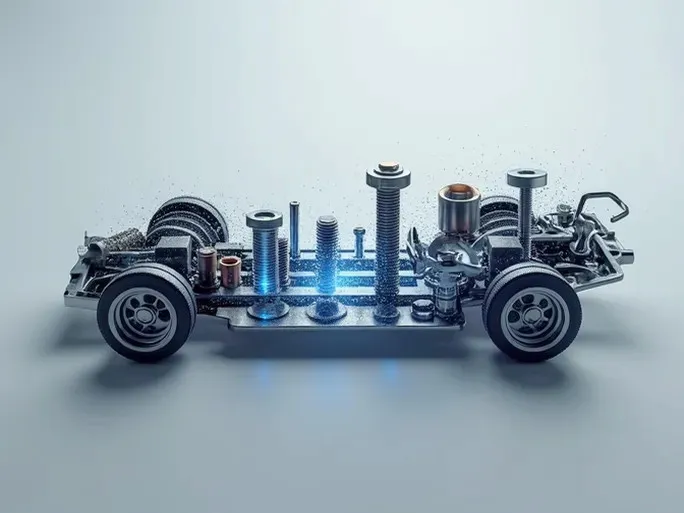
The automotive industry’s sophistication lies not only in complex mechanical structures and advanced electronic systems but equally in seemingly small yet crucial components – fasteners. These “connective tissues” that join various vehicle parts play an indispensable role in assembly, performance, and safety. This comprehensive guide explores automotive fasteners’ types, material properties, applications, and anti-loosening strategies.
Automotive Fasteners Overview
Automotive fasteners are standardized components used in vehicle manufacturing and maintenance to connect and secure parts. Through mechanical force or adhesive bonding, they unite multiple components into a cohesive structure. Despite diverse specifications, their core function remains ensuring reliable and stable connections.
Classification of Automotive Fasteners
Automotive fasteners can be categorized by material, function, or connection method:
By Material:
Metal (steel, aluminum) or non-metal (plastic) fasteners
By Function:
Bolts, nuts, screws, washers, pins, rivets, clamps, clips, and springs
By Connection Method:
Threaded, riveted, welded, adhesive-bonded, or press-fit connections
Materials Used in Automotive Fasteners
Material selection directly impacts strength, corrosion resistance, and lifespan. Common materials fall into two categories:
Metal Fasteners
Widely used in critical areas like engines, suspension systems, and body structures due to high strength and durability:
Steel:
The most prevalent material, available as carbon steel (high strength but poor corrosion resistance), alloy steel (enhanced properties through chromium/nickel), and stainless steel (superior corrosion resistance)
Aluminum Alloys:
Lightweight with good corrosion resistance, ideal for body panels and interior components
Copper Alloys:
Excellent conductivity and corrosion resistance for electrical connections
Surface treatments like zinc/nickel/chrome plating, phosphating, or anodizing further enhance performance.
Plastic Fasteners
Offer lightweight, cost-effective, corrosion-resistant solutions for interiors, electrical systems, and body attachments:
Polyamide (Nylon):
High strength and wear resistance for clips and screws
Polypropylene:
Chemical-resistant and economical for interior parts
Polyoxymethylene (POM):
High rigidity for precision components
Polycarbonate:
Impact-resistant transparent material for lighting components
11 Common Automotive Fastener Types
Nuts
Internal-threaded components mating with bolts/screws. Varieties include hexagonal, flange, cap, wing, and slotted nuts for different applications.
Bolts
External-threaded fasteners with heads, including hex-head, flange, carriage, and socket-head bolts for various connection needs.
Screws
Self-tapping, machine, wood, and set screws designed for direct insertion without nuts.
Self-Locking Fasteners
Specialized designs with nylon inserts, locking adhesives, or mechanical features to prevent vibration-induced loosening.
Rivets
Permanent fasteners including solid, hollow, and blind rivets for different assembly requirements.
Washers
Flat, spring, and locking washers that distribute load, absorb vibration, and prevent loosening.
Pins
Cylindrical, tapered, and cotter pins for precise component alignment and retention.
Clamps
Hose, pipe, and cable clamps for secure fluid and electrical line connections.
Clips
Spring, harness, and panel clips offering quick installation for interior and body components.
Springs
Helical, leaf, and torsion springs providing suspension, vibration damping, and mechanical energy storage.
Specialty Fasteners
Self-piercing rivets, weld studs, and adhesive fasteners for unique assembly challenges.
Anti-Loosening Strategies
Effective vibration resistance methods include:
- Self-locking fastener designs
- Friction-enhancing washers and adhesives
- Mechanical locking with pins or wire
- Regular inspection and maintenance
Proper Fastener Tightening
Correct torque application using calibrated tools is critical – under-tightening risks loosening while over-tightening may damage components. Always follow manufacturer specifications.
Application Areas
Fasteners serve throughout vehicles:
- Engine systems (cylinder head, crankshaft bolts)
- Chassis (suspension, wheel bolts)
- Body (doors, seat belts)
- Interior (dashboard, trim panels)
- Electrical systems (battery terminals)
Future Trends
Industry evolution drives fastener innovation:
- Lightweight materials (magnesium, composites)
- Enhanced strength through advanced metallurgy
- Smart fasteners with sensing capabilities
- Eco-friendly materials and processes
Conclusion
Automotive fasteners, though small, form the structural foundation of modern vehicles. Proper selection, installation, and maintenance ensure vehicle reliability and safety as technology advances.