
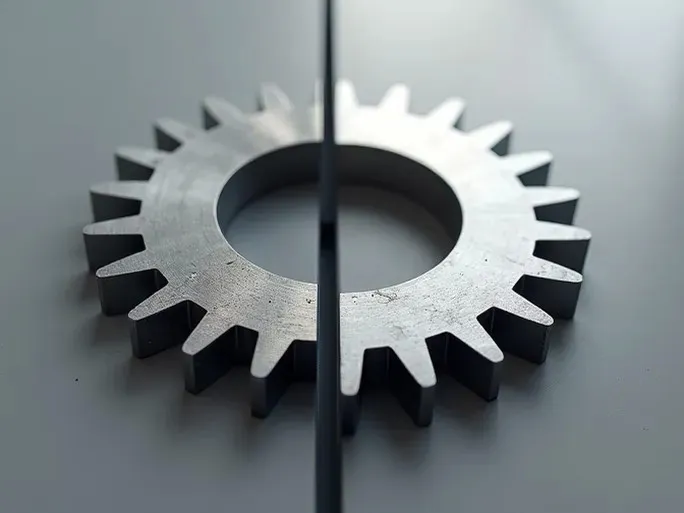
Imagine assembling a precision instrument where every component must be accurate to within fractions of a human hair’s width. Rough edges or dimensional variations would spell disaster. In metal part fabrication, selecting the right stamping process directly impacts product quality, cost efficiency, and manufacturing productivity. Today we examine two fundamental approaches: fineblanking versus conventional stamping.
Edge Quality: A Perfectionist’s Dream
Conventional stamping often produces rough edges with burrs and tears due to material fracturing and die wear. These imperfections compromise both aesthetics and functionality, typically requiring secondary deburring or chamfering operations that increase costs and lead times.
Fineblanking revolutionizes edge quality through specialized tooling that applies tri-directional force. This induces plastic deformation rather than fracture, yielding smooth, burr-free edges that frequently eliminate post-processing needs. For applications demanding flawless edges, fineblanking delivers unparalleled results.
Dimensional Accuracy: The Micrometer Challenge
Industries like automotive, aerospace, and medical devices demand extreme dimensional precision where micron-level deviations can impact performance or safety. Conventional stamping struggles with such tolerances due to variables like die precision, material properties, and press stability.
Fineblanking achieves remarkable accuracy through its “three-point” system:
Pressure Pad:
Clamps material like a corset to prevent movement
V-Ring Indenter:
Creates a pre-stressed zone to prevent tearing
Punch:
Executes precision cutting with surgical precision
This coordinated system routinely achieves micrometer tolerances for mission-critical components.
Material Efficiency: Sustainable Manufacturing
With growing emphasis on sustainable practices, material utilization becomes crucial. Conventional stamping generates significant scrap due to larger clearances and simpler geometries.
Fineblanking maximizes material usage through tighter clearances and complex nesting capabilities. It also processes challenging materials like high-strength steels and stainless alloys that conventional methods struggle with, further enhancing sustainability.
Complex Geometries: Engineering Marvels
Intricate designs featuring micro-holes, narrow slots, or gear teeth often exceed conventional stamping capabilities due to deformation risks. Fineblanking conquers these challenges through single-stroke production of sophisticated geometries without secondary operations.
Application Guidelines: Choosing Your Process
While fineblanking excels in precision, it carries higher tooling costs. Selection depends on:
Choose Fineblanking When:
- Micron-level tolerances required
- Flawless edges are mandatory
- Complex geometries are involved
- Specialty materials are used
- Production volumes justify costs
Conventional Stamping Works For:
- Moderate tolerance requirements
- Non-critical edge quality
- Simple part geometries
- Standard materials
- High-volume cost sensitivity
The Future of Precision
Advancements in fineblanking technology continue expanding its applications:
EV Components:
Battery contacts and motor laminations
Medical Devices:
Surgical blades and implants
Aerospace:
Lightweight structural components
As manufacturing evolves, fineblanking will play an increasingly vital role in delivering next-generation precision components across industries.